 Nicholas Young, Fictive Flame
 At Fictive Flame, storytelling is at the heart of everything we do. Whether it’s inspiring someone to try a new restaurant, chase an adventure, or learn a new skill, a great story always sparks curiousity and connection.
Over the past year, our mission to share engaging narratives has taken us to new heights. In early June, when our Founder and Creative Director, Nicholas, became an FAA certified Part 107 pilot, many creative opportunities were suddenly revealed. That certification isn’t just a badge of professionalism, it’s a legal necessity. Operating drones without it can lead to hefty fines for both the pilot and clients.
We’re proud of the operations record for our current aircraft, but safety concerns and the need to remain compliant ground many creative opportunities. Today, we’re turning the page on an exciting new chapter. We’ve evolved from flying drones to building them.
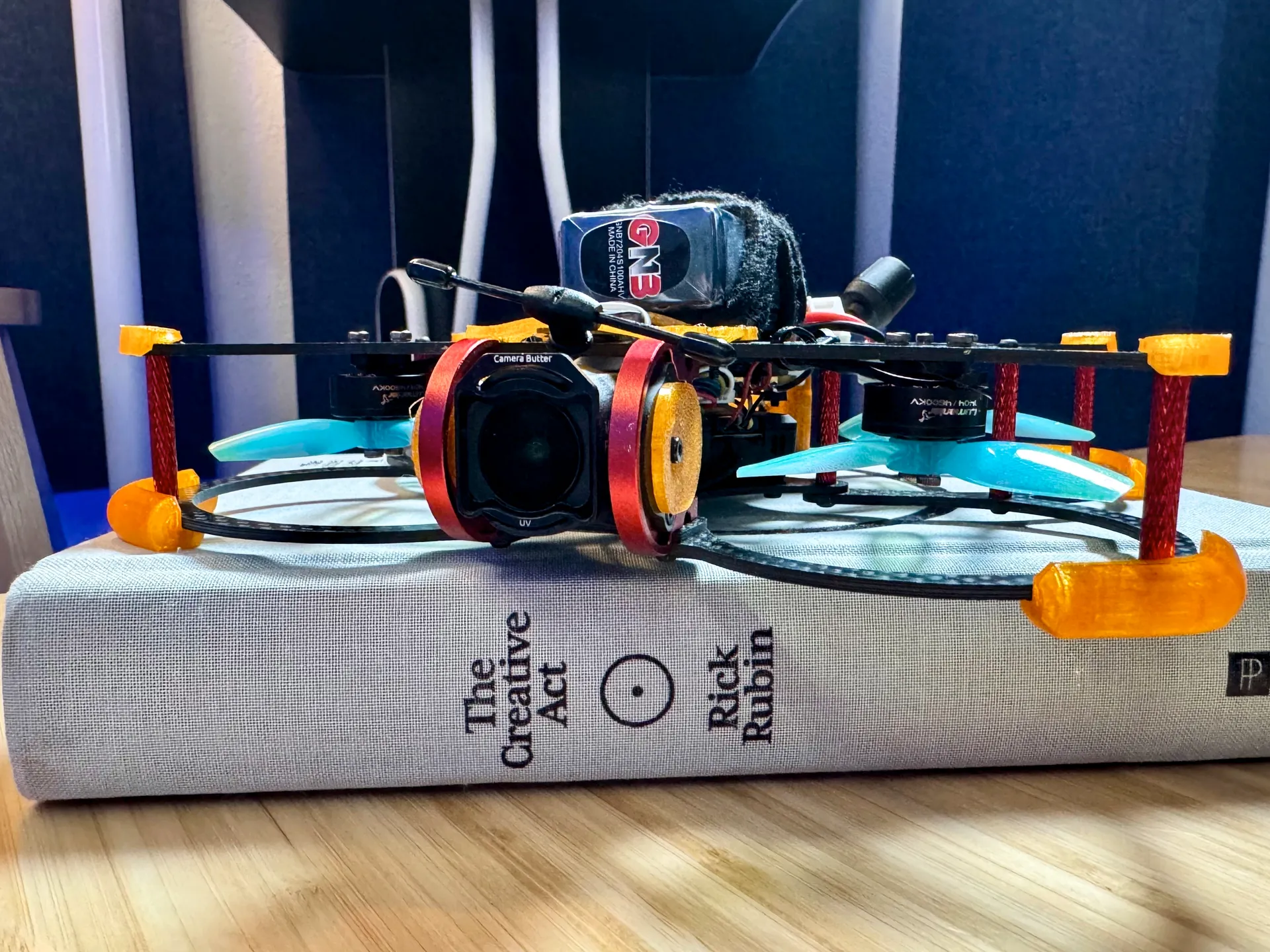
Introducing Fictive Air, our own American-made, Category 1 multirotor aircraft, purpose-built for cinematic flying in tight, dynamic environments. It’s designed by and for professional pilots, tuned to precision, and engineered to be compliant at liftoff.
FPV—short for “First Person View”—drones have redefined the boundaries of action cinematography. They offer an immersive experience by allowing pilots and the audience to see the drone’s view, in real time. This allows for incredible precision, weaving though obstacles and capturing unique, fluid footage.
Online, FPV flying has become it’s own cinematic genre: diving waterfalls, racing through abandoned structures, and soaring up cliff faces. Recently, that same style has evolved into something even more intimate: angles that place the camera mere feet, or inches, from people, cars, and other moving subjects. This new format of flying is powered by a drone known as a Cinewhoop.
Holding it in your hand is seemingly a paradox: how can it capture buttery smooth, 10-bit footage at up to 120 frames per second, with the takeoff weight of a typical remote control?
The answer lies in it’s lineage. Cinewhoops borrow inspiration from even smaller racing drones, which adopted propeller guards to help navigate tight, obstacle-filled environments and continue flying. We scaled those components up slightly, using 2.5” propellers and matching guards, to boost stability, outdoor wind resistance, and improve throttle response. This helps pilots get out of sticky situations quickly and safely.
Our existing drone fleet already included a Mavic 3 Pro, but it couldn’t meet all the requirements we had for events work. At the time of this post, there isn’t an ASTM parachute available for our model. What you might see online either isn’t FAA approved, or misses our own stringent requirements.
So, we set out to build something better: a drone that was under the weight limits so it didn’t require a Part 107 waiver, fully Remote ID compliant, capable of returning home under guidance of GPS when flown outdoors, and safe to operate over crowds of spectators. The one problem? Off the shelf drones all fell short. They either needed an improved propeller guard or required components to be switched out for FAA-compliant professional work.
When the order for our pre-built cinewhoop stalled for almost a month, we decided to build rather than compromise. The results aren’t just a drone, but a creative tool designed from the ground up to capture and share immersive stories.
Engineering a drone that balances FAA Category 1 compliance with cinematic performance was no small feat. Every screw, connector, and wire was carefully selected to remain under the weight limit.
Weighing in at just over 240 grams, both Fictive Air 2 and 3 are able to deliver up to 6 minutes of total flight time, and includes safety features that are often only available on larger aerial systems.
For instance, if the aircraft loses radio contact, it performs a two-step safety routine: hovering in place for up to 5 seconds for the link to be resolved, before landing safely or returning to the launch point, depending on the flight environment.
We custom-configure the flight software before each mission to match the demands and safety profile of the job.
When flying indoors, it’s calibrated to recover and keep flying after light bumps. However, in scenarios involving people or moving vehicles, even the lightest tap triggers an automatic shutdown, instantly stopping the propellers to prevent injury or damage. Video is constantly being recorded, not only to the drone itself, but to the pilot’s goggles, so every moment is preserved as an opportunity for refinement.
Fictive Air is already making its mark. You can spot footage from these small aircraft in our recent event recaps.
If your next event, brand shoot, or production needs next-level visuals, reach out. Let’s take flight, together.
You have a story. We have the gear and the goods, so why not reach out?